
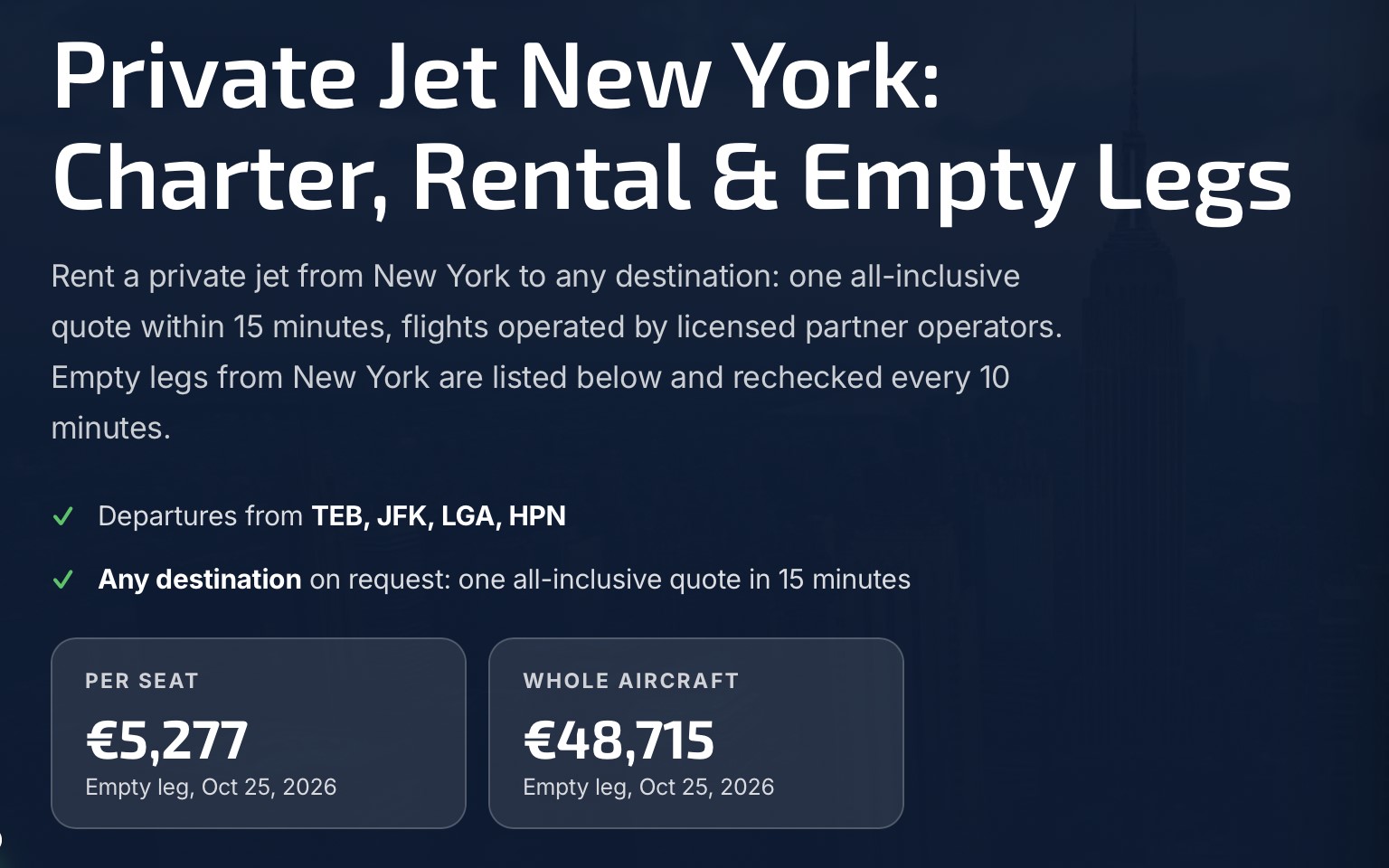
An overnight flight across the Atlantic can shape the working day that follows. Business travellers arriving in London may have meetings within hours of landing, while families heading to Paris or the Mediterranean often want to begin their holiday without complicated connections. For passengers considering private jet charter New York, (rentjet.eu/private-jet-new-york) the attraction lies in arranging a journey around their own requirements, from the departure airport to the arrival time in Europe. Yet crossing the Atlantic by private aircraft requires more preparation than a short domestic charter, particularly when flight range, passenger comfort and international operating requirements are involved.
New York has several airports used by private aviation, each offering different advantages. Teterboro is an established business aviation airport, while John F. Kennedy International, LaGuardia and Westchester County provide additional possibilities subject to their respective operating conditions. The most suitable departure point depends on the passenger’s location, aircraft type, destination and preferred schedule. Choosing the wrong airport can add unnecessary ground travel or complicate an otherwise straightforward journey.
Transatlantic charter flights also demand careful aircraft selection. A jet suitable for travelling between New York and Miami may not have the range required for a non-stop journey to London or Paris. Passenger numbers, luggage, weather conditions and fuel requirements can further influence the available options. Understanding these limitations before requesting a quotation helps travellers avoid unrealistic expectations about aircraft performance, flight duration and cost.
Choosing a Departure Airport in New York
Teterboro Airport in New Jersey is one of the principal airports serving private aviation in the New York metropolitan area. Located across the Hudson River from Manhattan, it is dedicated to general and business aviation rather than scheduled commercial airline services. Several fixed-base operators provide aircraft handling, passenger reception and other facilities associated with private flights. This infrastructure makes Teterboro a common choice for executives, private individuals and groups arranging charter journeys.
Its proximity to Manhattan is attractive, but ground travel can vary considerably according to traffic conditions. A passenger departing from Midtown may find Teterboro convenient, while someone travelling from eastern Long Island could face a substantially longer transfer. The precise location of the handling facility should also be confirmed before departure. Different operators use different facilities, and arriving at the wrong entrance can create unnecessary delays.
Teterboro has specific operating restrictions that must be considered during aircraft selection. The airport does not accommodate scheduled commercial airline services, and its runway characteristics and aircraft weight limitations affect the types of aircraft permitted to operate there. Some larger long-range jets may therefore require a different departure airport. International flights must also comply with the relevant customs and border requirements.
John F. Kennedy International Airport offers an alternative for aircraft requiring facilities suitable for larger international operations. Its extensive runway infrastructure can accommodate many long-range business aircraft, although private flights must operate within a busy commercial aviation environment. Airport slots, handling availability, charges and traffic conditions can influence whether JFK is appropriate for a particular charter. Its location may be convenient for passengers travelling from parts of Queens, Brooklyn or Long Island.
Westchester County Airport, north of New York City, is another established business aviation location. It can be useful for passengers based in Westchester, southern Connecticut or nearby communities who wish to avoid travelling into the city. Dedicated aviation handling services support private aircraft, but airport restrictions and aircraft suitability must be assessed individually. A convenient ground location does not guarantee that every transatlantic aircraft can operate from the airport under all conditions.
LaGuardia may also accommodate certain private aviation movements, subject to applicable airport rules and operational restrictions. However, its congestion, slot controls and other limitations make it less straightforward for some international charter requirements. In addition, LaGuardia is not generally suitable for routine long-haul international departures. Travellers should therefore regard it as a possible option for particular operations rather than an automatic alternative to Teterboro or JFK.
The departure airport should be selected together with the aircraft and destination. A conveniently positioned smaller jet may offer advantages for certain European routes, while a larger aircraft carrying more passengers and luggage could require different facilities. Comparing ground access, operational permissions and total charter costs provides a more reliable basis for choosing between New York’s airports.
Selecting an Aircraft for an Atlantic Crossing
A transatlantic private flight requires an aircraft capable of covering a substantial distance while carrying its passengers, luggage and necessary fuel reserves. The distance between New York and London is approximately 5,550 kilometres, while journeys to Paris, Zurich or destinations farther east can involve longer flight sectors. Actual routes vary according to air traffic arrangements, weather and the airports selected. The aircraft’s published maximum range is therefore only a starting point when assessing whether a non-stop flight is practical.
Long-range and ultra-long-range business jets are commonly considered for these journeys. Aircraft in this category are designed for extended flights and generally provide larger cabins than short-range models. Depending on their configuration, they may include separate seating areas, suitable workspaces and facilities for rest during overnight travel. However, cabin arrangements differ between individual aircraft, and passengers should confirm the actual equipment rather than rely on generic descriptions of a particular model.
Aircraft range deserves careful interpretation. Manufacturers normally publish performance figures based on defined operating assumptions, which may not match the conditions of a specific charter. Passenger load, baggage, headwinds, routing and required fuel reserves can reduce practical range. A flight that is possible non-stop in favourable conditions may require an additional fuel stop when circumstances change.
Westbound and eastbound Atlantic crossings can also produce different flight durations. Prevailing winds at cruising altitude frequently favour eastbound journeys from North America towards Europe, while westbound flights may encounter stronger headwinds. The precise effect varies according to the season and weather patterns. Passengers should therefore request realistic flight-time estimates for their particular route rather than assume that the outward and return journeys will take the same amount of time.
Several considerations help determine which aircraft is most appropriate.
- Practical range. Confirm that the aircraft can operate the intended route with the planned passenger load and required fuel reserves.
- Passenger capacity. Consider seating configuration, available space and the comfort of everyone travelling.
- Luggage requirements. Large suitcases, sporting equipment and specialist items can affect the aircraft’s usable payload.
- Cabin facilities. Sleeping arrangements, seating flexibility, catering and connectivity may be important on an overnight flight.
- Airport compatibility. Runway characteristics, aircraft weight restrictions and handling requirements can limit departure and arrival options.
Selecting a jet with substantially more capacity than required may increase costs without providing a meaningful benefit. Conversely, an aircraft that appears economical could prove unsuitable if it requires a fuel stop or cannot accommodate the intended baggage. The most appropriate option balances operating performance, comfort and the complete cost of the journey.
Planning Arrival in Europe
The choice of arrival airport can have as much influence on convenience as the departure arrangements in New York. London offers several airports used by business aviation, including Farnborough, Biggin Hill and Luton. However, not every transatlantic aircraft can use every airport without restrictions. Runway requirements, operating hours and aircraft availability must be considered before selecting a destination.
Travellers heading to central London may initially prefer the airport that appears closest on a map. Yet road conditions and the location of the final destination can change the calculation. Someone attending meetings in the City may have different priorities from a passenger travelling to Surrey or a property outside London. A departure from New York that saves an hour could lose much of that advantage if the arrival airport requires an unnecessarily long transfer.
Paris offers similar considerations. Paris Le Bourget is an established business aviation airport, while Charles de Gaulle provides infrastructure suitable for extensive international operations. The most convenient choice depends on aircraft characteristics, airport availability and the passenger’s onward journey. Travellers heading towards other French regions may also benefit from examining alternative airports closer to their final destination.
Other European cities require individual assessment. Zurich, Milan, Munich and Vienna all have airport facilities capable of supporting international private aviation, but their operating conditions differ. Larger aircraft may face restrictions at smaller airports, while customs, immigration and handling services must be available for the proposed arrival. A charter provider should assess these matters before confirming the itinerary.
For passengers continuing to another European destination, a multi-sector arrangement may be worth considering. A business group could fly from New York to London, attend meetings and then continue to Paris or Zurich using the same aircraft, subject to the operator’s permissions and schedule. Such arrangements can reduce the complexity of coordinating several separate bookings. However, additional flight sectors, airport charges and crew requirements will influence the overall cost.
Arrival times also deserve attention. Overnight departures from New York commonly reach Europe the following morning because of the time-zone difference. Travellers should consider how much rest they will obtain during the flight and whether important commitments are scheduled too soon after landing. A private cabin provides opportunities for rest and work, but it does not eliminate fatigue associated with long-distance travel.
Ground transport should be arranged before departure. Private aviation facilities may be situated away from an airport’s main passenger terminal, and drivers need accurate instructions about where to collect passengers. This is particularly important when travelling with several people or substantial luggage. A well-organised transfer can prevent avoidable delays after a long flight.
Understanding the Cost of a Transatlantic Charter
Hiring a private aircraft for a journey between New York and Europe represents a substantial financial commitment. Long-range jets require significant fuel, qualified flight crews and extensive operational support. Aircraft category and flight duration influence the price, but the final quotation also reflects airport charges, positioning movements, handling services and other requirements. The cost cannot be determined reliably from distance alone.
Aircraft positioning is an important consideration. If a suitable long-range jet is already available in New York, the operator may be able to arrange the charter without an additional flight to collect passengers. If the aircraft must travel from another location, that movement may be included in the price. Similar costs can arise after passengers arrive in Europe if the jet needs to return to its base or reposition for another assignment.
The structure of a return journey also affects pricing. A passenger visiting London for two days may require a different arrangement from a family spending three weeks in several European countries. Keeping the same aircraft available throughout a long stay may involve considerable parking, crew accommodation and other expenses. In some circumstances, arranging separate outbound and return charters could provide better value.
A return flight may also require different operational planning. Westbound Atlantic journeys can take longer because of prevailing winds, potentially affecting fuel requirements and aircraft range. A jet capable of completing the eastbound sector without stopping may face more demanding conditions on the return flight. The operator should assess each direction separately rather than assume identical flight performance.
Passengers with flexible schedules may occasionally find empty leg opportunities involving transatlantic routes. These arise when an aircraft must reposition without passengers before or after another charter assignment. Operators may offer such flights at reduced prices, but their availability is unpredictable. The departure time, route and sometimes the aircraft itself can depend on the original booking.
Empty legs are therefore better suited to travellers whose plans can accommodate uncertainty. A discounted flight may be attractive for a flexible leisure journey, but it is less suitable when passengers must arrive for a particular meeting or event. Booking conditions should explain what happens if the repositioning flight is changed or cancelled. Travellers should also make independent arrangements for the return journey unless a suitable confirmed option is available.
Before accepting a quotation, passengers should establish exactly what the agreed price includes. Crew costs, fuel, airport handling, catering, taxes and relevant operational charges should be clearly explained. Additional services, itinerary changes and cancellation conditions also deserve careful review. Comparing complete quotations is more useful than selecting an apparently attractive price without understanding the contractual terms.
Preparing for International Travel
Private aviation offers considerable flexibility, but passengers must still comply with international travel requirements. A flight departing from New York for Europe involves documentation and procedures that differ from those associated with domestic travel. Passport validity, visas and permission to enter the destination country depend on the traveller’s nationality and circumstances. Passengers should check these requirements before confirming arrangements that may involve significant cancellation costs.
European destinations do not all operate under identical immigration rules. The United Kingdom maintains its own entry requirements, while many continental European countries participate in the Schengen Area. Switzerland belongs to Schengen but is not a member of the European Union, creating distinctions in certain customs arrangements. Travellers visiting several countries should understand which rules apply at each stage of their itinerary.
The aircraft operator must also complete the necessary flight planning and regulatory procedures. International operations can involve customs notifications, passenger information submissions, flight plans and compliance with applicable aviation permissions. Passengers should provide accurate documentation and personal details within the timeframe requested by the operator. These procedures remain necessary even when a private terminal offers a more individualised departure experience.
Long-distance charter flights also require coordination of catering, luggage and cabin arrangements. Travellers intending to sleep during an overnight crossing may benefit from confirming whether the aircraft has appropriate reclining or sleeping facilities. Passengers planning to work should check the availability and limitations of onboard connectivity. Those carrying specialist equipment or travelling with pets need to establish the relevant arrangements before departure.
Weather and air traffic conditions can influence transatlantic flight planning. Strong winds, turbulence, changes in routing and airport congestion may affect the expected journey time. Operators must also account for suitable alternative airports and required fuel reserves. A private charter allows passengers to request a preferred schedule, but the captain and operating company remain responsible for decisions affecting safety.
The practical value of a transatlantic charter becomes clearer when these details are considered together. A group travelling from New York to several European cities may benefit from coordinated flights, suitable arrival airports and the ability to travel without unrelated passengers. For an individual travelling between cities served by frequent non-stop airline services, a scheduled business-class journey may offer considerably better value. The appropriate choice depends on the purpose of the trip, the number of passengers and the importance of flexibility.
A successful private flight between New York and Europe is built around decisions made before the aircraft leaves the ground. Selecting an airport that suits the passengers, confirming an aircraft with sufficient practical range and arranging the arrival procedures all contribute to a reliable journey. Clear pricing and realistic scheduling are equally important. When every stage is coordinated around the travellers’ requirements, private aviation can offer an effective solution for complex transatlantic itineraries without relying on unnecessary promises of speed or luxury.